Buying Guides
How to Measure Your Ring Size at Home
Quick answer: to check your ring size at home, either wrap a narrow strip of non-stretch paper around the intended finger and measure the marked length in millimetres, or measure the inside diameter of a ring that already fits that same finger. Repeat the measurement, then compare the millimetre result with the exact Indian ring size guide supplied by the seller rather than relying on an unverified conversion chart.
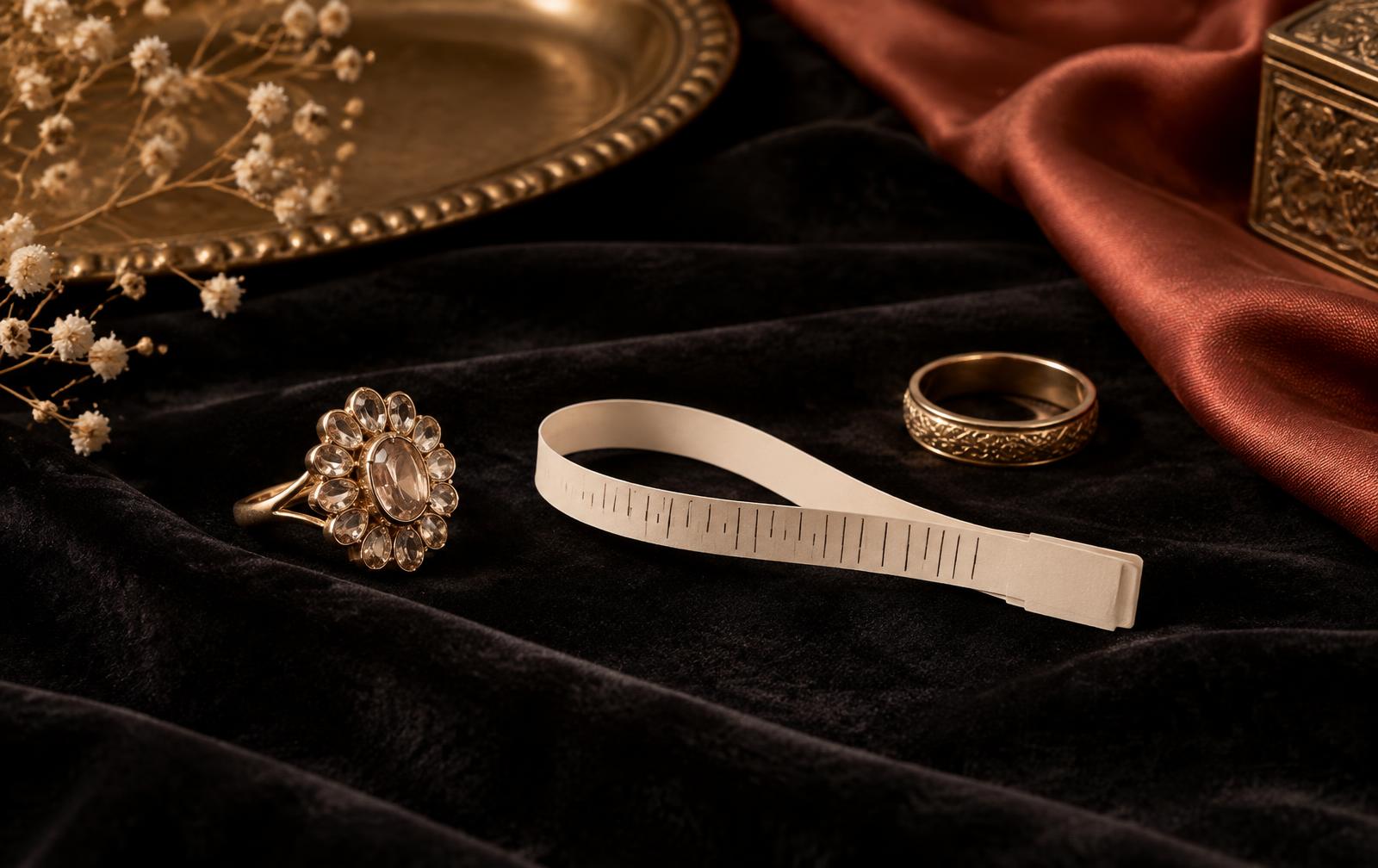
Before you measure: choose the correct finger
Decide which finger and which hand will wear the ring before taking a measurement. The corresponding fingers on your left and right hands may not be the same size, particularly if one is your dominant hand. Measure the intended finger rather than copying the size of another finger.
Finger size can shift slightly with temperature, time of day and normal daily activity. Measure when your hands feel comfortable—not unusually cold, hot or swollen. If possible, check at two or three different times and use the result that appears most consistently.
Method one: measure ring size using an existing ring
Choose a round ring that fits the intended finger comfortably. Place it flat on a ruler marked in millimetres. Measure the inside diameter straight across the widest point through the centre, from one inner edge to the other. Do not include the band itself or any decorative border.
Measure the inside diameter two or three times, checking that the ruler passes through the true centre each time. If the ring is slightly out of shape, measure in two directions and do not use it as your only reference. A ring worn on a different finger is also unlikely to give a dependable result.
Record the inside diameter in millimetres and compare it with the sizing information for the ring you plan to buy. Indian ring size numbers can vary from other international systems, so use the seller's own chart or listed dimensions. This guide deliberately does not provide an unverified conversion table.
Method two: the paper or string method
Cut a narrow strip of plain, non-stretch paper. If paper is not available, use a thin, non-stretch string, but paper is usually easier to keep flat. Wrap it around the base of the intended finger so it feels comfortably close without pinching or leaving a gap.
Mark the exact point where the paper or string overlaps. Lay it flat against a ruler and measure from the starting edge to the mark in millimetres. This number is your finger circumference. Record it clearly as circumference—not diameter—so the two measurements are not confused.
Repeat the process at least twice with a fresh strip if needed. The loop should also pass over the knuckle with gentle resistance, particularly when the knuckle is wider than the finger base. Avoid elastic, thick ribbon or fluffy string because each can distort the result.
How to check ring size at home more accurately
For many hands, the knuckle is the widest point a ring must cross. Measure both the knuckle and the place where the ring will sit. If the numbers differ, look for a fit that can pass the knuckle but will not feel excessively loose at the base.
A little resistance over the knuckle can be normal, but a ring should not require force, pinch the skin or cause discomfort. Once in place, it should feel secure rather than spin constantly or slide off when the hand points downward. Comfort and easy circulation matter more than an extremely close fit.
Allow for band width and ring shape
Broad bands often feel closer than slim bands because more of the finger is covered. A substantial design may therefore need a little more room than a fine ring in the same nominal size. Rings with an open or adjustable construction should be assessed according to the product's own directions rather than treated like a fixed closed band.
Large decorative tops can also affect how secure a ring feels. If the centrepiece is heavier or wider, a fit that is too loose may rotate more easily. Check product dimensions and photographs so you understand the scale as well as the listed size.
What to do between sizes
If your measurement falls between two available fixed sizes, consider the band width, your knuckle and when you plan to wear the ring. The larger option often offers more comfort for a broad band, a prominent knuckle or fingers that change size during the day. A slimmer band may feel secure in the nearer size if it still moves over the knuckle comfortably.
Do not convert or round a measurement without checking the seller's Indian ring size guide. If the difference remains unclear, ask for the internal diameter or circumference of the exact sizes available. For a gift, measuring a ring the recipient already wears on the same finger is generally more dependable than estimating from appearance.
Measurement tips and common mistakes
- Do not measure a cold finger immediately after coming indoors or a swollen finger after heat or activity.
- Keep paper snug but never pull it so tightly that it presses into the skin.
- Measure the inside—not the outside—of an existing ring.
- Record both the number and unit clearly; 17 mm diameter is not the same measurement as 17 mm circumference.
- Repeat the measurement on different occasions before deciding.
- Avoid relying on printable ring guides unless their scale has been checked after printing.
Ring size questions, answered
- Should I use paper or string? A narrow, non-stretch paper strip is easier to keep flat. Thin non-stretch string can work if it is marked carefully and measured without pulling.
- Is diameter or circumference better? Both can be useful. Existing rings give an inside diameter; measuring the finger gives a circumference. Keep the measurement type and millimetres clearly labelled.
- Can I use a general ring size chart for India? Use the chart supplied for the specific product whenever possible. Numbered sizing systems and conversions are not always identical between sellers.
- When should I ask for help? Contact the seller if your readings vary, you fall between sizes, or the product page does not state whether its measurement is diameter, circumference or a numbered size.